Sovereignty · Aviation · Systems
The Civilizational Airliner
How the Gulf Turns Aircraft into Instruments of Sovereignty
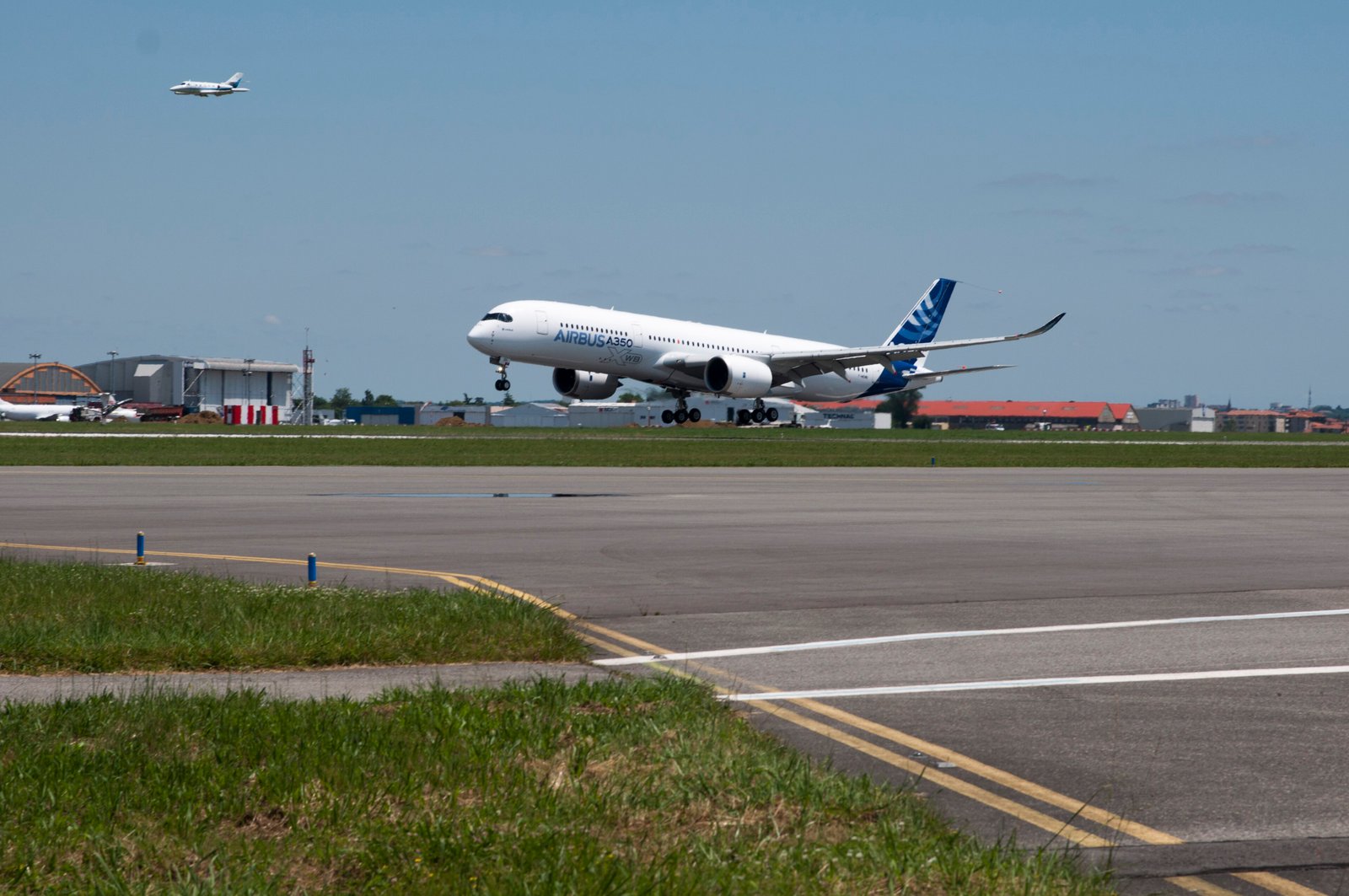
On the morning of 14 June 2013, an aircraft lifted quietly from the runway at Toulouse–Blagnac Airport.
From the outside, it appeared to be another successful milestone in commercial aviation. Engineers observed telemetry, test crews monitored performance, and photographers captured the first images of what would become Airbus' newest flagship.
The aircraft was the Airbus A350 XWB.
Its first flight lasted only a few hours.
Its institutional journey had barely begun.
Aircraft are usually introduced through engineering. Their range is measured. Their fuel consumption is compared. Their cabins are reviewed. Their efficiency becomes the subject of analysis.
Yet history rarely remembers commercial aircraft because of their technical specifications alone. Some machines eventually become part of something larger than transportation. They reorganize trade. They alter diplomatic geography. They redefine the movement of capital. They change how nations project themselves beyond their borders. Long before passengers notice them, institutions have already begun assigning them new functions.
The A350 would eventually become one of those machines. Not because it flew farther than previous aircraft. Nor because it consumed less fuel. But because, once integrated into a broader institutional architecture, it became one of the instruments through which aviation's sovereign function could be quietly exercised.
Its story therefore begins not in the sky, but in the gradual expansion of what an aircraft can ultimately represent.
The Machine Europe Assembled
The Airbus A350 was never the product of a single country. It emerged from one of the largest industrial collaborations ever assembled in commercial aerospace.
Its wings were manufactured in the United Kingdom. Its forward fuselage sections came from France. Major structural components arrived from Germany. Horizontal tailplanes were produced in Spain. Thousands of suppliers in Europe and beyond contributed systems, avionics, composites and specialized manufacturing capabilities before final assembly took place in Toulouse.
The aircraft itself therefore represented something larger than industrial production. It represented the ability of multiple sovereign states to maintain a shared technological ecosystem over decades.
This level of coordination cannot be improvised. Certification standards must converge. Supply chains must remain reliable. Engineering languages must remain compatible. Political continuity must outlast electoral cycles. Industrial trust must survive financial crises. Every aircraft delivered embodies years of accumulated institutional coordination that passengers never observe.
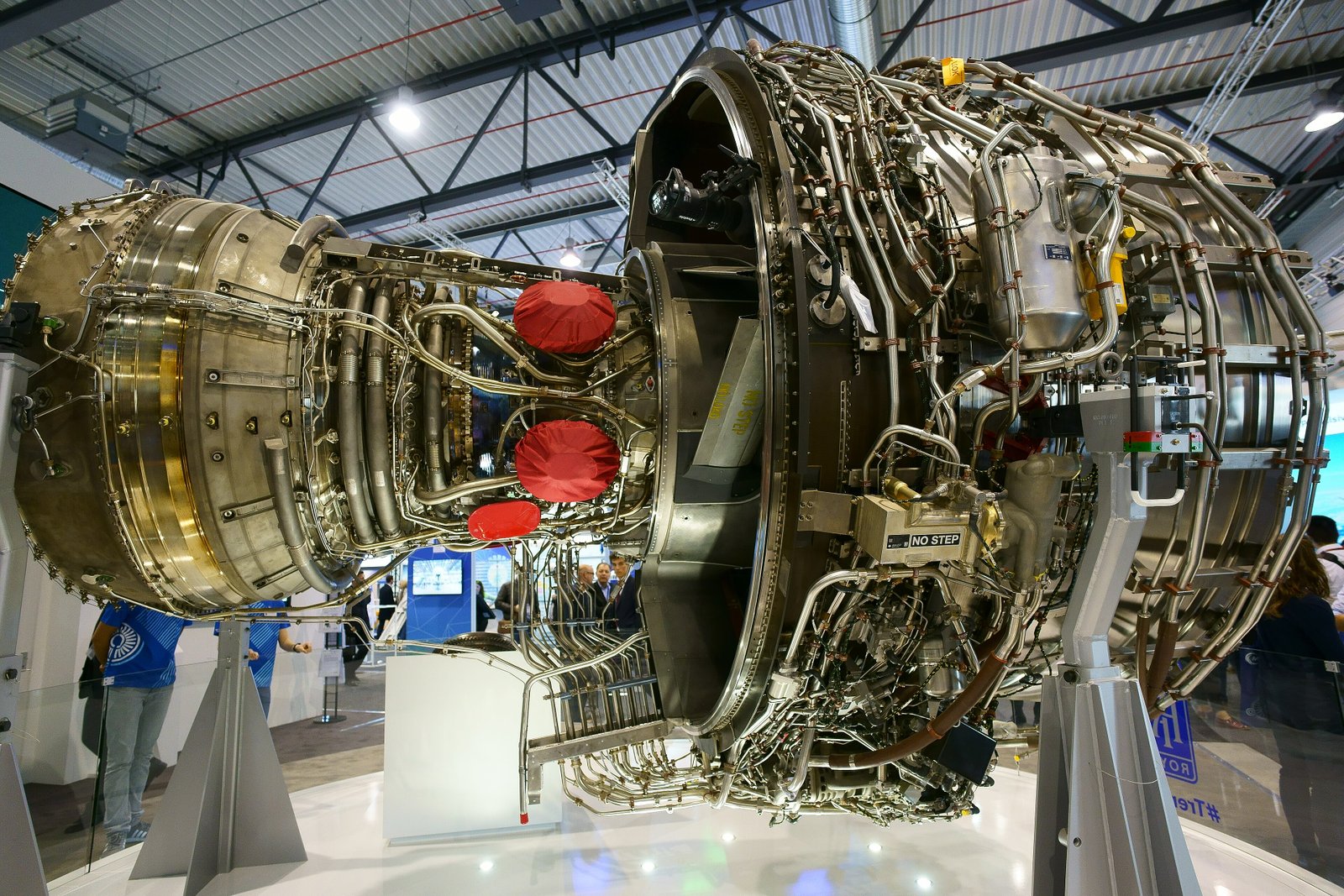
Even its engines illustrate this logic. The Rolls-Royce Trent XWB was developed exclusively for the A350 family after years of engineering cooperation between manufacturer, suppliers and certification authorities. Efficiency was therefore not simply designed. It was institutionally assembled.
By the time the aircraft entered service, thousands of technical decisions made across multiple countries had already been consolidated into a single operational platform. What appeared to be one aircraft was, in reality, an integrated European system capable of reproducing precision at global scale.
Yet engineering alone never determines historical significance. Many remarkable aircraft remain remarkable machines. Only a few become strategic instruments. That transformation begins once technology is absorbed into institutions capable of assigning it new purposes.
The Requalified Object
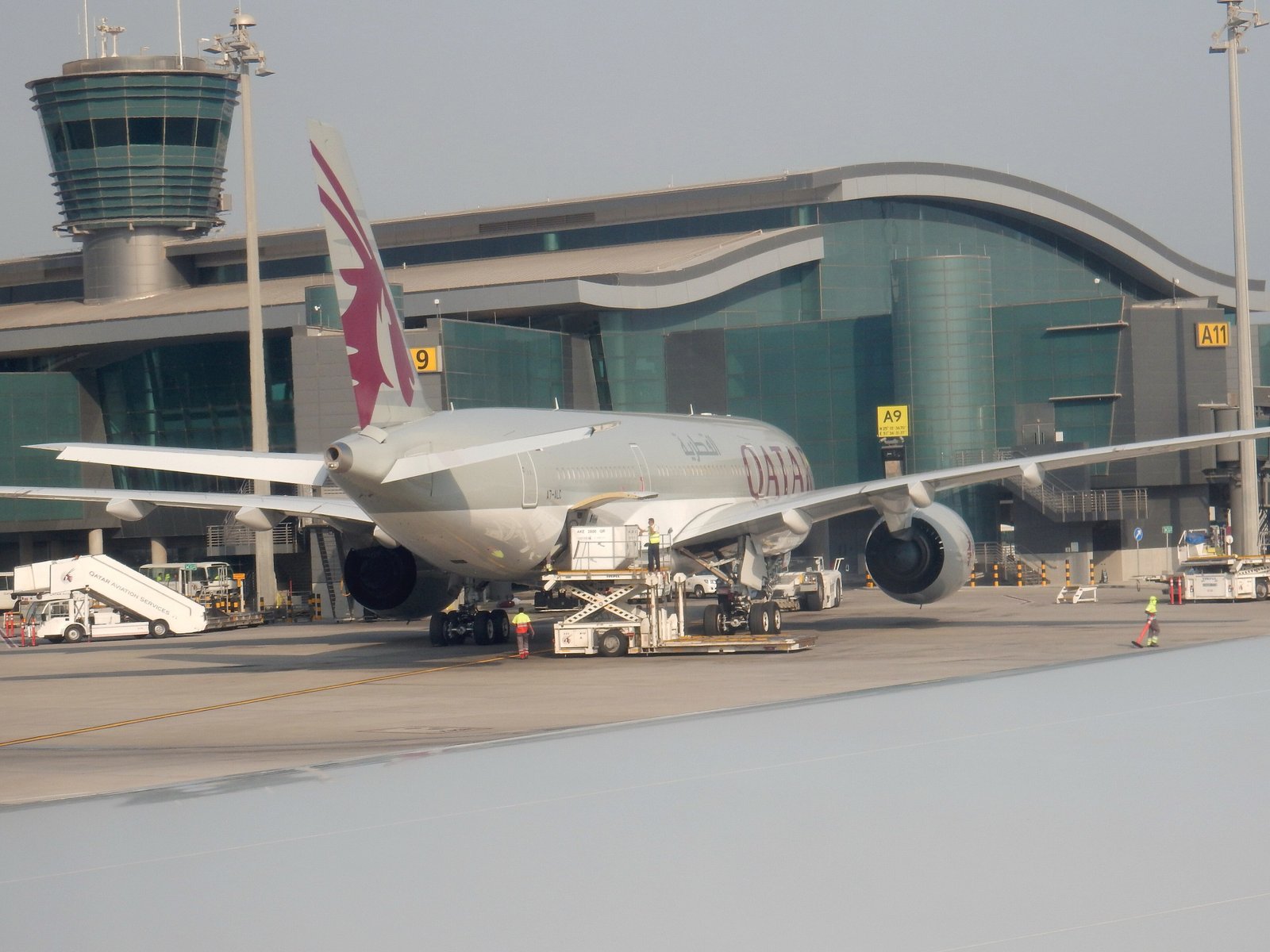
The Airbus A350 entered commercial service with Qatar Airways in January 2015.
From a technical perspective, this represented the successful completion of years of development. From a strategic perspective, it marked the beginning of something considerably more important.
Aircraft acquire meaning through the systems into which they are introduced. The same airframe may perform entirely different geopolitical functions depending on the network that surrounds it.
Within Qatar Airways, the A350 became more than an efficient long-range aircraft. It became part of a continuously coordinated architecture linking infrastructure, scheduling, regulation, maintenance, financing, international agreements and diplomatic access.
Its value therefore exceeded fuel efficiency or passenger comfort. Each additional destination strengthened a larger operational network. Each new route increased institutional familiarity between airports, regulators, logistics providers and governments. Each successful operation reinforced confidence that future movements could be organized with equal reliability.
Over time, the aircraft ceased to be evaluated only by what it could technically accomplish. It began to be valued by the continuity it helped sustain.
Technology had quietly become infrastructure. Infrastructure had begun to shape geography. And geography was gradually becoming strategy.
When Range Becomes Reach
Range is a property of an aircraft. Reach is a property of a system.
The distinction is fundamental. An aircraft may be capable of flying thousands of kilometres without creating any durable strategic advantage. Technical endurance alone does not determine which cities can be served, how frequently they can be connected, or whether those connections can be maintained through disruption.
Reach emerges only when range is joined to infrastructure, scheduling, traffic rights, maintenance capacity, commercial demand and institutional continuity.
This was the larger significance of the A350 within the Gulf. Its long-range capability mattered because it entered a hub architecture designed to convert distance into organised access.
Doha did not merely receive aircraft. It coordinated them. Arrivals from one region were aligned with departures to another. Passenger flows were concentrated, redistributed and sustained through a single operational centre. Routes that might have been marginal as isolated services became viable as components of a wider network.
The aircraft therefore acquired strategic value through repetition. A single flight demonstrates capability. A stable schedule creates expectation. A dense network creates dependence. When businesses, families, governments and supply chains begin planning around the continued availability of those connections, the airline ceases to function only as a transport provider. It becomes part of the surrounding architecture of economic and political life.
This is the point at which range becomes reach. The transformation is not spectacular. It appears gradually in timetables, bilateral agreements, maintenance routines, transfer windows and passenger habits. Yet its consequences are substantial. A state able to sustain reliable movement across multiple regions gains a form of presence beyond the conventional boundaries of territory. It does not annex space. It organises access to it.
The map remains unchanged. The practical geography does not.
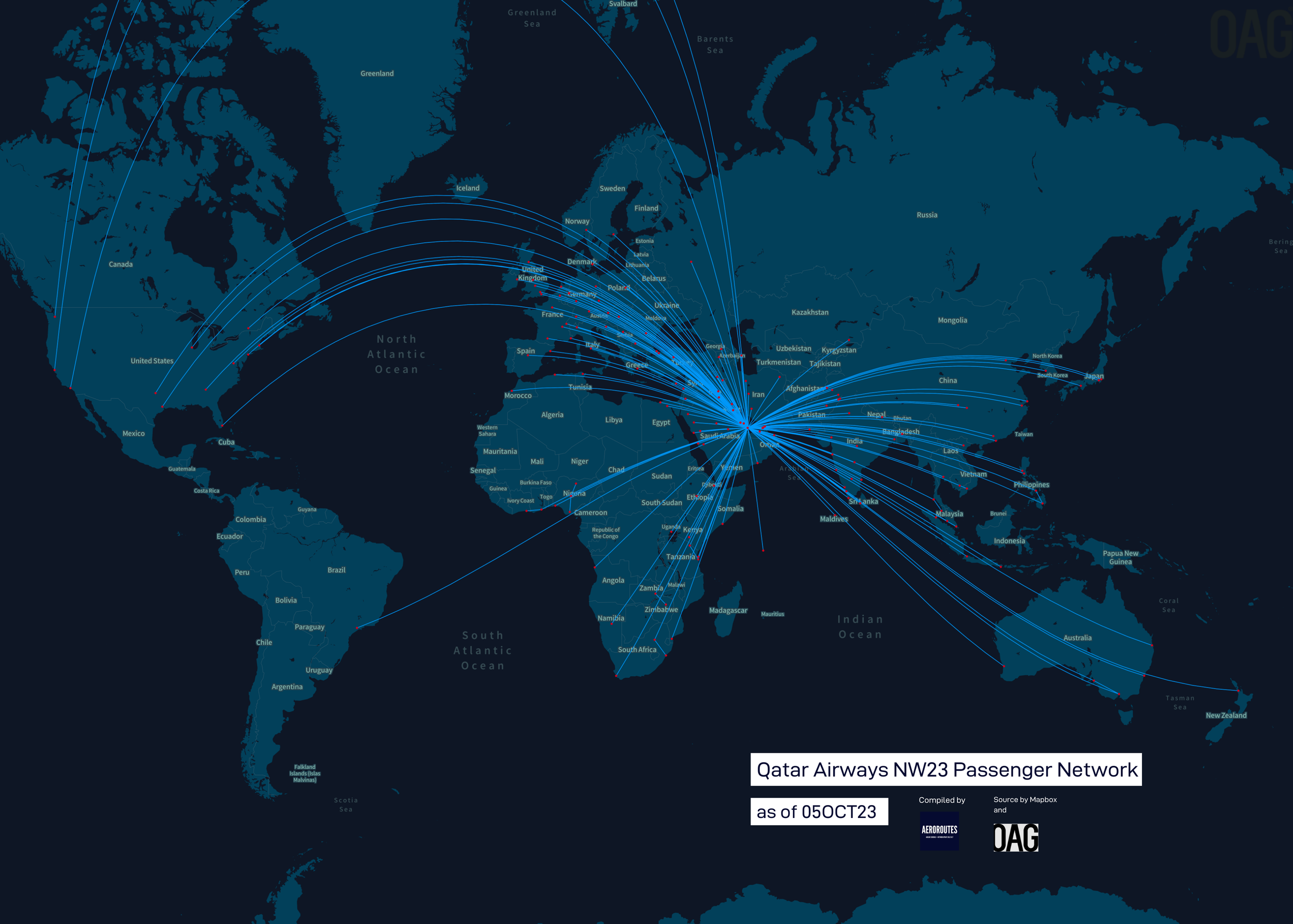
A network centred on Doha compresses places that remain distant on a conventional map. Cities separated by oceans, political systems and commercial traditions become operationally adjacent through the hub.
The strategic achievement lies not simply in connecting Doha to the world. It lies in positioning Doha between parts of the world that increasingly need to reach one another. Europe and South Asia. Africa and East Asia. The Gulf and the Americas. Secondary cities and global markets.
Each route contributes more than its own traffic. It strengthens the usefulness of every other route that can be reached through the same system. Network power is cumulative. The value of a hub grows as the number, frequency and reliability of its connections increase. An additional destination does not merely extend the map. It enlarges the number of possible journeys that the entire system can support.
The aircraft becomes a multiplier within that structure. Its range permits distant sectors. Its capacity supports concentrated flows. Its efficiency helps maintain frequencies that might otherwise be commercially fragile. Its commonality with the broader fleet reduces the complexity of operating the network at scale.
But none of these advantages is sovereign by itself. Their strategic meaning appears only when they are coordinated toward a durable national purpose.
The A350 did not give Qatar geography it did not possess. It helped Qatar manufacture a more useful geography from the location it already had.
The Industrial Lever
The relationship between Qatar Airways and the A350 was not limited to the purchase of finished aircraft. As launch customer, the airline occupied a privileged position in the transition between industrial design and operational reality.
Launch customers matter because new aircraft do not enter service as abstract technical objects. They enter demanding environments shaped by climate, route structure, maintenance practices, passenger expectations and commercial pressure. Early operations reveal what laboratory testing cannot fully reproduce. Cabin systems behave differently under constant use. Turnaround routines expose design friction. Heat, dust and intensive scheduling test reliability. Maintenance teams encounter patterns invisible during development. Pilots, engineers and dispatchers translate specifications into daily practice.
The first operator therefore participates, directly or indirectly, in the maturation of the platform. This creates a form of industrial leverage. The purchasing state is no longer only a consumer of foreign technology. Through the scale of its order, the intensity of its operations and the visibility of its network, it becomes part of the environment in which that technology is refined.
The relationship remains asymmetric, and it is not always harmonious. The dispute between Qatar Airways and Airbus over A350 surface degradation and the grounding of aircraft demonstrated how operational dependence could become industrial and legal confrontation. On 1 February 2023, the two companies announced a confidential settlement, without any admission of liability by either party. The episode illustrated both the influence of a major airline customer and the limits of that influence. The manufacturer retains the deeper industrial base, engineering authority and production capacity.
This is not technological sovereignty in the conventional sense. Qatar did not design or manufacture the A350. It did something different. It embedded itself within the life of the programme at the moment when the aircraft still required operational validation. That position created influence without ownership.
It also revealed a broader Gulf strategy: acquire advanced systems, operate them at exceptional scale, and use their integration to increase national capability. The leverage lies not in producing every component domestically. It lies in becoming difficult to exclude from the system through which those components acquire commercial meaning.
The Architecture of Permission
Aircraft do not move through empty space. Every international flight passes through a dense architecture of permission.
Traffic rights must be negotiated. Airspace must remain open. Crews must be certified. Aircraft must be registered and insured. Maintenance must comply with recognised standards. Security procedures must be accepted. Payments must clear. Slots must be allocated. Passengers and cargo must be admissible at both ends of the route.
The visible journey depends on an invisible accumulation of authorisations.
This architecture places a limit on purely technical interpretations of aviation power. An aircraft may possess sufficient range to reach a city while the airline lacks the legal right to serve it. A route may be commercially attractive while airport capacity remains unavailable. A fleet may be modern while political relations restrict its use. A hub may be geographically well positioned while surrounding airspace becomes inaccessible.
Movement is therefore never created by machinery alone. It is produced through the continuous alignment of technical capability and institutional permission.
The states of the Gulf understood this early. Their airlines expanded alongside airports, bilateral agreements, regulatory institutions, diplomatic relationships and service ecosystems capable of supporting movement at scale. The aircraft formed only the most visible layer. Behind it stood civil aviation authorities, route negotiators, airport operators, sovereign investors, maintenance organisations, training systems and government institutions working across different time horizons.
This coordination transformed aviation from a commercial sector into an instrument of state capacity. Not every decision was centrally directed. Not every route served an explicit geopolitical purpose. The system did not need to operate through a single command structure to produce sovereign effects.
Its power came from alignment. Separate institutions, each performing its own function, collectively increased the state's ability to connect, attract, reroute and endure.
This is composed sovereignty: power assembled across multiple institutions rather than contained within one. Its resilience depends on the quality of coordination between them. Its weakness appears when one layer is treated as independent of the others. An airline without airspace access cannot convert fleet strength into movement. An airport without a coherent network cannot convert infrastructure into reach. A network without diplomatic continuity cannot convert reach into durable influence. The architecture works only while its permissions remain aligned.
The Civilizational Airliner
The phrase may appear excessive. An airliner is, after all, a manufactured object. It consists of composite structures, software, engines, hydraulic systems and thousands of components designed to move passengers and cargo.
Yet certain machines become civilizational when the systems around them assign functions larger than their original design. Railways became instruments of territorial integration. Ports became foundations of maritime power. Telecommunications networks reorganised political and economic distance. None of these systems ceased to be technical infrastructure. Their civilizational significance emerged from the scale of the human order they made possible.
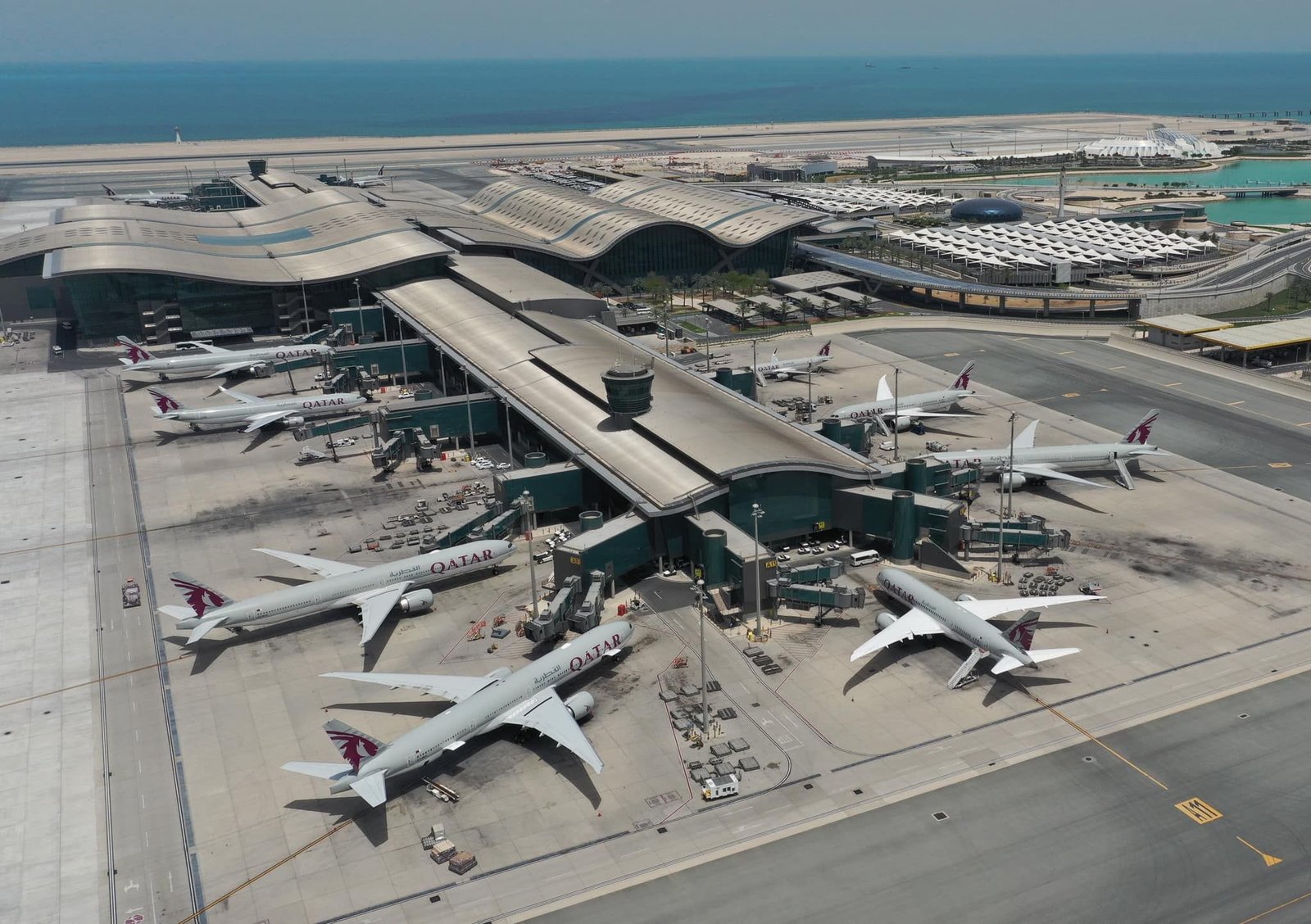
The same is true of the long-range airliner. Within the Gulf, aircraft such as the A350 help sustain a model of statehood built around movement. They bring populations through hubs. They connect domestic ambition to foreign markets. They carry executives, tourists, labour, families, officials, medical patients and high-value cargo. They support events, institutions and investment strategies whose viability depends on international accessibility. They allow relatively small states to participate in global systems at a scale disproportionate to their population or territory.
The aircraft becomes civilizational not because it represents a civilization in any essential or cultural sense. It becomes civilizational because it supports a particular organisation of space, time and sovereignty. The Gulf model is not based primarily on territorial depth. Its power emerges from the ability to coordinate flows. Capital must arrive. People must transit. Goods must move. Expertise must remain accessible. International institutions must be able to operate within a predictable environment.
The continuity of movement becomes inseparable from the continuity of the state's economic project. In this context, the airliner is not a decorative symbol of modernity. It is one of the machines through which modernity is maintained. Its cabin may display national aesthetics. Its livery may project prestige. Its service may shape international perceptions. But its deeper value lies elsewhere. It helps preserve the practical conditions under which the state remains connected to the systems on which its prosperity depends.
The aircraft carries passengers. The system carries sovereignty.
Power Without Announcement
Traditional power often announces itself. It appears in military deployments, political declarations, territorial claims and formal alliances.
The power created by aviation networks is quieter. It accumulates through reliability. A flight departs. A transfer is completed. A route is restored after disruption. A new city enters the network. An airport expands without interrupting the movement already passing through it.
No single event appears decisive. Together, they create confidence that the system will remain available. That confidence has strategic value. Companies choose locations partly because executives and staff can reach them. Investors consider not only the asset, but the infrastructure that keeps the asset connected. Tourism depends on the persistence of access. Diplomatic relevance increases when a state becomes a practical meeting point between regions. Supply chains become more resilient when alternative routes can be organised through a capable hub.
The power lies in becoming useful to the movement of others. Usefulness can create influence without coercion. It can also create dependency without formal obligation. A traveller may select Doha for convenience. A company may rely on the hub for efficiency. A government may value the route because it preserves access to a distant region. Each decision remains voluntary. But as these decisions accumulate, the system becomes embedded in the routines of institutions far beyond the state that operates it.
This is sovereignty exercised through continuity rather than command. It does not eliminate vulnerability. The architecture remains dependent on external manufacturers, foreign airspace, international demand, global finance and political permission. Its sophistication can obscure those dependencies rather than remove them. A state that organises movement at global scale must constantly preserve the conditions that permit movement to continue. Its strength and exposure grow together.
The A350 therefore embodies a paradox. It expands reach while revealing dependence. It projects national capability through a machine built abroad. It strengthens the hub while tying the hub to a wider industrial, regulatory and geopolitical order. It makes distant cities accessible while relying on permissions that may never be fully controlled by the operator.
This does not diminish its strategic importance. It defines it more accurately. Sovereignty in complex systems rarely means independence from every external actor. It means retaining sufficient capacity to coordinate dependencies without becoming paralysed by them.
The Gulf did not turn the A350 into an instrument of sovereignty by possessing the aircraft alone. It did so by surrounding the aircraft with institutions capable of converting technical performance into persistent movement.
Europe assembled the machine. The Gulf requalified its purpose. Between them emerged an object that belonged fully to neither world. It remained a commercial aircraft. It also became a component of a larger political architecture: one through which geography could be reorganised, access could be sustained and national presence could travel far beyond territorial scale.
On 14 June 2013, the A350 lifted from Toulouse as an engineering achievement. Its range could already be calculated. Its fuel efficiency could be measured. Its performance could be tested. What could not yet be measured was the institutional life that would later surround it. The routes. The permissions. The infrastructure. The diplomatic access. The accumulated confidence of millions of journeys.
Only after entering that architecture did the aircraft acquire its fullest meaning. The first flight proved that the machine could fly. The system that followed demonstrated what the machine could become.
— Curated Sovereignty
Selected Sources
The following sources document the A350 programme, its international manufacturing structure, its introduction into Qatar Airways' fleet, and the subsequent industrial dispute. The essay's interpretation of aviation as an instrument of sovereignty is an editorial analysis, not a conclusion attributed to these sources.
- Airbus. Annual Report / Registration Document 2014. Documents the A350's first flight on 14 June 2013 and its first delivery to Qatar Airways on 22 December 2014.
- Airbus. A350 Family. Aircraft design, performance, production geography and international supply chain.
- Airbus. A350 XWB Programme Update, 22 January 2015. Records the first delivery and the start of commercial operations on the Doha–Frankfurt route on 15 January 2015.
- Airbus. Airbus Delivers Its First A350-1000 to Launch Customer Qatar Airways, 20 February 2018.
- Airbus. Ready for Service! Qatar Airways Is the First Airline to Receive Airbus' A350-1000, February 2018. Operational and fleet context for the A350-1000 introduction.
- Airbus. Qatar Airways Grows Its A350-1000 Fleet, 1 October 2018. Documents the airline's decision to convert five A350-900 orders to the larger variant.
- Airbus and Qatar Airways. Qatar Airways and Airbus Reach Amicable Settlement in Legal Dispute, 1 February 2023. Joint statement concerning A350 surface degradation, aircraft groundings and a confidential settlement without admission of liability.
Author's Note
Questions for Future Research
Measuring Sovereign Reach — How might sovereign reach be distinguished from ordinary network size? A meaningful measure would need to extend beyond fleet numbers, passenger volumes and the number of destinations served. It would examine the diversity of regions accessible through the system, the frequency and substitutability of its connections, the political variety of the network and the degree to which access can be maintained during disruption. The deeper question is not how far an aircraft can fly. It is how much usable geography a state can preserve through the institutions surrounding it.
Identifying the Threshold of Institutional Requalification — At what point does a commercial asset cease to function merely as a purchased product and begin to operate as a strategic institution? The transition may occur when the continuity of the asset begins to affect several sectors simultaneously, when it becomes embedded within national planning, or when external actors start organising their own behaviour around its reliability. A framework for institutional requalification could help identify comparable transformations in ports, cloud infrastructure, logistics corridors, payment systems and energy networks.
Measuring Hub Sovereignty — What constitutes sovereignty within a hub? Passenger throughput alone is insufficient. A serious measure might include route diversity, transfer efficiency, diplomatic access, regulatory credibility, recovery speed, airspace flexibility and the capacity to continue operating when one route, corridor or partner becomes unavailable. The appropriate unit of analysis may not be the airport itself, but the complete institutional architecture that protects the movement passing through it.
Mapping the Architecture of Permission — Which permissions are most decisive in converting technical range into operational reach? International aviation depends on traffic rights, overflight access, airport slots, certification recognition, security arrangements, insurance, financial clearing and political relations. These permissions are commonly analysed separately even though their strategic effects are cumulative. A more complete model would identify where permission is concentrated, where it is substitutable and where an apparently global network remains dependent on a small number of external decisions.
Evaluating Launch-Customer Influence — How much influence can a launch customer exercise over an industrial programme it does not own? The answer may depend on order size, operational intensity, technical expertise, market visibility and the manufacturer's need for a successful entry into service. Future research could distinguish ceremonial launch-customer status from genuine operational leverage and examine whether early participation produces lasting influence over configuration, reliability, maintenance practices or programme development.
Quantifying Composed Sovereignty — How can sovereignty assembled across several institutions be measured? Airlines, airports, regulators, diplomatic services, sovereign investors, maintenance organisations and training systems may remain institutionally separate while producing a combined strategic capability. Traditional analysis often searches for a single directing authority. Composed sovereignty may instead require measuring alignment: the degree to which distinct institutions reinforce a shared capacity without operating through one formal hierarchy.
Pricing Dependency Within Reach — Does greater reach necessarily produce greater sovereignty? A global aviation network creates access, but it also introduces dependency on foreign manufacturers, engines, spare parts, software, airspace, financial systems and regulatory recognition. A serious assessment of sovereign reach must therefore measure both the geography gained and the dependencies created in obtaining it. The strongest network may not be the one with the widest map. It may be the one whose critical dependencies remain visible, diversified and governable.
Valuing Continuity — What is the economic and political value of preserving movement when competing systems become unavailable? Continuity is usually recognised only after disruption. Yet the expectation that routes, transfers, infrastructure and permissions will remain available can shape investment, tourism, corporate location, diplomatic relevance and institutional trust long before a crisis occurs. A model of continuity value could reveal why certain aviation systems matter far beyond the revenue recorded by the airlines operating them.
Measuring Manufactured Geography — Can the practical compression of distance created by a hub be quantified? Physical distance remains unchanged, yet scheduling density, transfer reliability and network coordination can make remote cities operationally closer to one another. Future research might measure this manufactured geography through total journey time, frequency, resilience, connection quality and the number of viable economic or institutional relationships made possible by the hub.
Locating the Limits of Network Power — At what point does usefulness become vulnerability? A state may gain influence by making itself useful to the movement of others. But the greater the network's importance, the greater the consequences when it is interrupted. Research should therefore examine whether network centrality always strengthens sovereign capacity or whether, beyond a certain threshold, it creates obligations and exposures that reduce freedom of action.
Related Concepts
Sovereign Reach — The usable geography a state can access and sustain through coordinated networks, institutions and permissions. Sovereign reach differs from technical range. It concerns not the maximum distance a machine can travel, but the extent of movement a political system can preserve reliably.
Institutional Requalification — The process through which a commercial or technical object acquires a function larger than the purpose for which it was originally designed. An aircraft becomes institutionally requalified when it is integrated so deeply into infrastructure, regulation and national strategy that its operation begins to affect the state's broader capacity.
Hub Sovereignty — The ability to organise, maintain and redirect flows through a strategically positioned centre. Hub sovereignty depends on more than physical infrastructure. It emerges from the coordination of routes, capacity, institutions, permissions and continuity.
Manufactured Geography — The creation of practical proximity between places that remain physically distant. A hub manufactures geography when scheduling, infrastructure and network density make remote cities operationally accessible through a shared system.
Architecture of Permission — Architecture of Permission — The layered legal, diplomatic, regulatory and commercial authorisations that allow movement to occur. Technical capability remains dormant unless permission converts it into usable access. Related to Permission Infrastructure (The Corridors).
Composed Sovereignty — Sovereign capacity produced through the alignment of multiple institutions rather than concentrated within a single authority. Its strength lies in coordination. Its vulnerability lies in the possibility that one critical layer may cease to support the others.
Curated Sovereignty examines strategic questions whose answers are still emerging.