Institutions · Finance · Connectivity
The Invisible Corridor
How London and Dubai Compete Without Becoming Substitutes
In February 2004, Sir Anthony Evans arrived in Dubai to find much of the future financial centre still unbuilt. He later recalled sand surrounded by a ringed fence.
Evans had spent sixteen years in the senior English judiciary, the last eight in the Court of Appeal. Four years after leaving the bench, he was now helping to establish the structure and rules of a new court in Dubai.
Over the following year, the court took shape. Proceedings would be conducted in English, under procedures drawing heavily on the common-law tradition. Yet the legal order being constructed was neither an extension of the English courts nor an importation of English law. It belonged to a new statutory jurisdiction created within the Dubai International Financial Centre.
In April 2005, Evans became its first Chief Justice.
The journey from London to Dubai had carried legal experience across thousands of kilometres without carrying the jurisdiction with it.
Dubai had built another.
That difference matters.
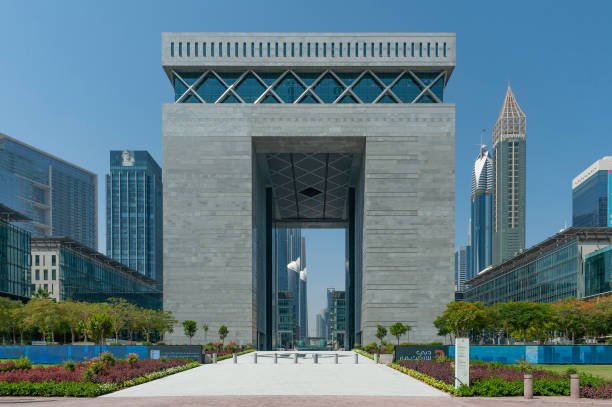
I. The Architecture of Difference
Established in 2004 as a financial free zone within the United Arab Emirates, the Dubai International Financial Centre developed a civil and commercial legal framework distinct from the federal framework surrounding it, with its own statutory laws and courts operating within the common-law tradition, while federal criminal law and other applicable federal obligations remained in force.
This was not a gesture of deference to London. It was a construction decision.
The DIFC created a distinct civil and commercial legal order within the UAE. Its courts operated in English, with judges drawn from jurisdictions where the common-law tradition had developed over centuries.
The centre remained within the constitutional and judicial order of the Emirates while creating a space where international capital could encounter legal forms it already understood.
For institutions accustomed to common-law reasoning, the architecture reduced one form of legal unfamiliarity without eliminating the need to understand DIFC law itself. An investor still had to know the rules of the zone. The familiarity was in the mode of reasoning, not in the specific statutes.
The distinction was not symbolic: it determined which law governed contracts entered into under DIFC jurisdiction, which judges resolved disputes, and which legal order the parties accepted when they submitted their affairs to the centre. Dubai had not imported English law. Instead, it had constructed a legal environment that made English legal experience usable without making English institutions sovereign.

Five years later, Evans described the ambition in less abstract terms: the DIFC Courts should “evolve as a common law court alongside the local civil courts,” allowing common-law procedures to operate “in harmony with local civil law courts.”
Compatibility did not require equivalence.
II. Capital Does Not Need One Home
London and Dubai are often placed in opposition. One narrative presents Dubai as an ascendant financial centre drawing capital, talent and institutions away from established hubs. Another dismisses the Gulf as a transient destination for wealth that will return to London once conditions shift.
Both narratives assume that the two cities compete for the same functions, and that one must eventually prevail.
The architecture of the DIFC suggests something different.
Governance, administration, custody, investment management and operating activity need not occupy the same jurisdiction. International financial and professional firms already maintain operations across London and the DIFC, allowing different parts of a cross-border structure to be handled in different centres.
When functions are distributed in this way, the geography of capital becomes a geography of functions. London may provide legal architecture, custody and advisory depth. Dubai may provide the operating base, regional deployment and access to Gulf commercial networks.
Capital has not necessarily moved from one centre to another. Its functions have been distributed between them.
Competition remains real. London and Dubai compete for talent, for prestige, for institutional attention. They compete for some of the same firms and some of the same capital. But competition for presence does not imply the displacement of function. The same institution can use both cities.
The two cities need not become substitutes. They can become complementary without ceasing to compete.
III. The Geography of Private Continuity
Capital is only one dimension of the corridor connecting London and Dubai. Private life moves along the same route.
London and Dubai are linked by substantial direct aviation capacity, with Emirates alone operating twelve daily services in each direction across Heathrow, Gatwick and Stansted. Distributed arrangements acquire friction when movement between their components becomes difficult. Frequency determines whether that connectivity remains occasional or becomes operational.

Cross-border private wealth can involve functions that do not naturally converge in a single jurisdiction. Education, business access, residence and professional advice may each remain anchored in different places.
The corridor becomes the infrastructure through which these functions are integrated — not simply a line between two airports, but a geography of professional and personal continuity sustained by institutions.
Mobility becomes strategic when moving no longer requires starting again. The same principle extends to privacy.
The DIFC Family Wealth Centre, established in 2023, did not create the corridor. It formalised something already taking shape: dedicated institutional treatment of family governance, succession and private wealth within the DIFC framework.
Applicable disclosure, compliance or regulatory obligations remain. Privacy concerns the conditions under which information is held and accessed, rather than its institutional absence.
Discretion, when institutionalised, is not invisibility. It is governed visibility.
IV. The Complementary City
A global city does not need to own the entire relationship with the capital, talent and institutions that pass through it. Its importance can rest on performing a specialised part of that relationship reliably.
London's value lies in capabilities that have accumulated around law, finance, professional services, education and institutional depth. Dubai's proposition rests on a different combination: regional access, infrastructure, international connectivity and increasingly sophisticated financial and private-wealth frameworks.
Each city is strengthened not by becoming more like the other but by performing its own function with sufficient reliability that the connection between them remains workable.
The DIFC Family Wealth Centre, established in 2023, did not create the corridor. Its significance lies elsewhere: the DIFC had given family governance, succession and private wealth dedicated institutional treatment within its framework.
What holds for London and Dubai applies elsewhere. Global cities can gain influence by specialising within a network rather than attempting to internalise every function. When rules no longer align — when connectivity deteriorates or trust erodes — the cost falls not on one city but on the families and institutions that have built their continuity across both.
Conclusion — The Axis
In 2004, Sir Anthony Evans arrived in Dubai carrying experience formed within the English judiciary. The court he helped establish would not belong to that judiciary. It would become part of Dubai's own legal architecture.
Two decades later, the distinction remains useful. London and Dubai compete for capital, firms and talent, yet institutions operating across both do not necessarily require one city to replace the other. Different functions can remain anchored in different places for as long as the legal, professional and physical connections between them continue to work.
That is what makes the corridor consequential.
The distance between London and Dubai is measured in hours. Their real proximity is institutional.
— Curated Sovereignty
Author's Note
Concepts Introduced
Functional Distribution — The allocation of legal, financial, operational or private functions across multiple jurisdictions without requiring a single centre to contain the entire institutional architecture.
Institutional Proximity — The condition in which geographically distant centres become functionally closer through compatible legal frameworks, professional networks, infrastructure and connectivity.
Questions for Future Research
1. Can institutional proximity be measured?
2. When does functional distribution strengthen continuity, and when does it create dependency?
3. How durable is institutional proximity when regulatory frameworks diverge?
4. Does complementarity between financial centres reduce competition or change its form?
5. Can the London–Dubai pattern be observed between other global financial centres?
Selected Sources
Federal Law No. 8 of 2004
Financial Free Zones, United Arab Emirates
Dubai Law No. 9 of 2004
The Dubai International Financial Centre
Dubai Law No. 12 of 2004
Judicial Authority
DIFC Law No. 10 of 2004
Court Law
DIFC Law No. 3 of 2004
Law on the Application of Civil and Commercial Laws
Dubai International Financial Centre
Family Arrangements Regulations 2023. In force 31 January 2023
Dubai International Financial Centre
DIFC Family Wealth Centre, 2023
Krishnan, Jayanth K.
The Story of the DIFC Courts: A Retrospective, 2018
TheCityUK
Legal Excellence: The UK as a Global Centre for Legal Services, 2024
Emirates Airline
Flight Schedules: London Heathrow, Gatwick, Stansted to Dubai, accessed 2026
Curated Sovereignty examines strategic questions whose answers are still emerging.